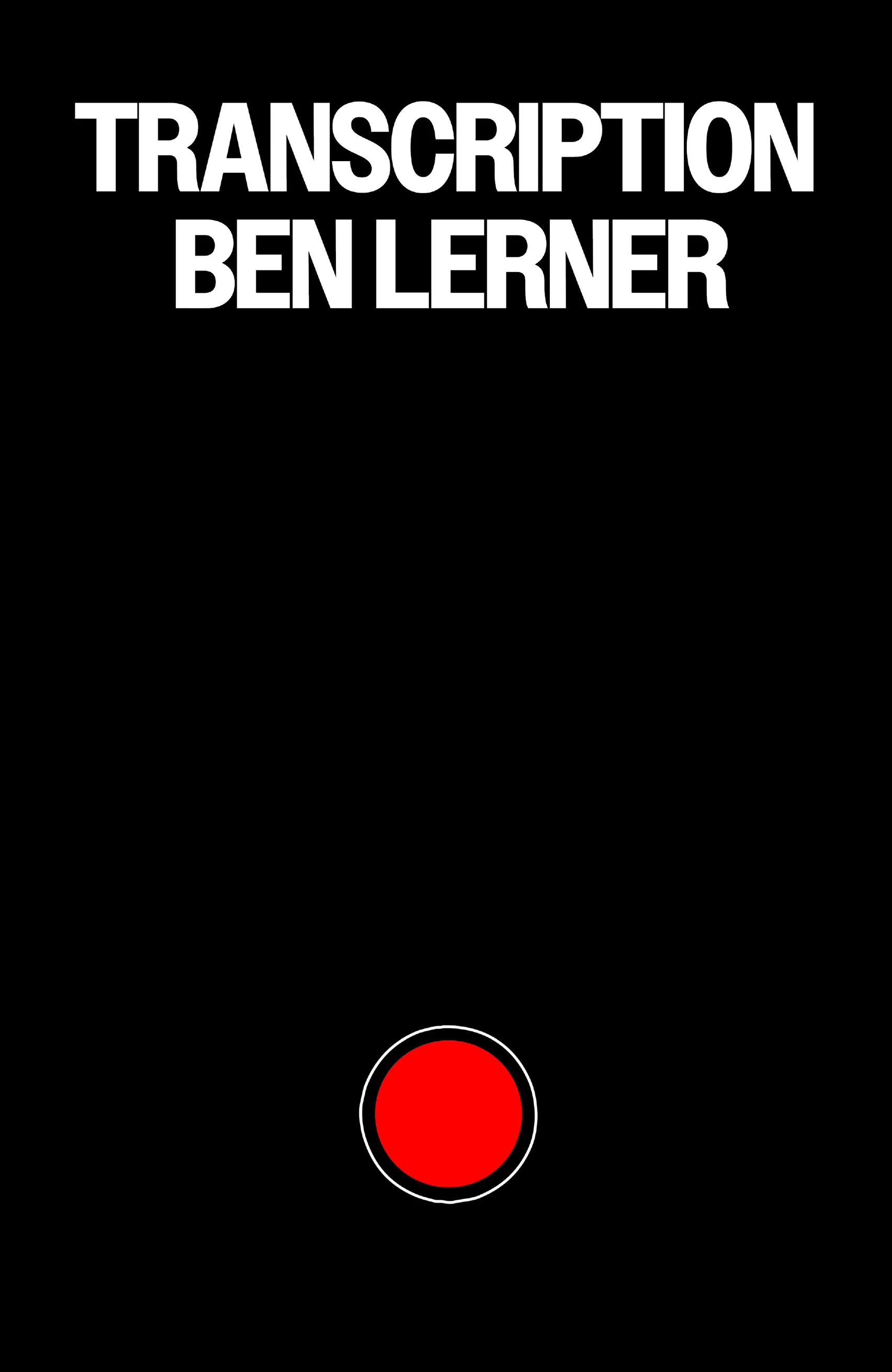
Transcription
CLAIRE'S PICK
It’s confusing, writing about Transcription. Its characters are confused, and so is its time. It feels almost impossible to describe the density of memory, perception, and voice that carries the novel; especially impossible to describe it while also giving equal weight—and one must!—to its completely easygoing beauty, the smoothness of its wash, the thrill of its sentences coming to inform—even invent, or originate—your own senses as you read it. - CF
From the “most talented writer of his generation” (The New York Times), a lightning flash of a novel that is at once a gripping emotional drama and a brilliant examination of the devices, digital and literary, we use to store—or to erase—our memories.
The narrator of Ben Lerner’s new novel has traveled to Providence, Rhode Island, where he is to conduct what will be the final published interview with Thomas, his ninety-year-old mentor and the father of his college friend, Max. Thomas is a giant in the arts who seems to hail “from the future and the past simultaneously” and who “reenchants the air” when he speaks. But the narrator drops his smartphone in the hotel sink. He arrives at Thomas’s house with no recording device, a fact he is mysteriously unable to confess.
What unfolds from this dreamlike circumstance is both the unforgettable story of the triangle formed by Thomas, Max, and the narrator, and a brilliant meditation on those technologies that enrich or impoverish our connection to one another, that store or obliterate memory. Haunted by Kafka (there are echoes of “The Judgement” and “A Hunger Artist”), but utterly contemporary, Lerner combines trenchant insight with lyric mystery. Ultimately, Transcription demonstrates what only a work of fiction can record.
Hardcover | 176 pages | 5.50" x 8.50"
Original: $18.97
-65%$18.97
$6.64Transcription
CLAIRE'S PICK
It’s confusing, writing about Transcription. Its characters are confused, and so is its time. It feels almost impossible to describe the density of memory, perception, and voice that carries the novel; especially impossible to describe it while also giving equal weight—and one must!—to its completely easygoing beauty, the smoothness of its wash, the thrill of its sentences coming to inform—even invent, or originate—your own senses as you read it. - CF
From the “most talented writer of his generation” (The New York Times), a lightning flash of a novel that is at once a gripping emotional drama and a brilliant examination of the devices, digital and literary, we use to store—or to erase—our memories.
The narrator of Ben Lerner’s new novel has traveled to Providence, Rhode Island, where he is to conduct what will be the final published interview with Thomas, his ninety-year-old mentor and the father of his college friend, Max. Thomas is a giant in the arts who seems to hail “from the future and the past simultaneously” and who “reenchants the air” when he speaks. But the narrator drops his smartphone in the hotel sink. He arrives at Thomas’s house with no recording device, a fact he is mysteriously unable to confess.
What unfolds from this dreamlike circumstance is both the unforgettable story of the triangle formed by Thomas, Max, and the narrator, and a brilliant meditation on those technologies that enrich or impoverish our connection to one another, that store or obliterate memory. Haunted by Kafka (there are echoes of “The Judgement” and “A Hunger Artist”), but utterly contemporary, Lerner combines trenchant insight with lyric mystery. Ultimately, Transcription demonstrates what only a work of fiction can record.
Hardcover | 176 pages | 5.50" x 8.50"
Product Information
Product Information
Shipping & Returns
Shipping & Returns
Description
CLAIRE'S PICK
It’s confusing, writing about Transcription. Its characters are confused, and so is its time. It feels almost impossible to describe the density of memory, perception, and voice that carries the novel; especially impossible to describe it while also giving equal weight—and one must!—to its completely easygoing beauty, the smoothness of its wash, the thrill of its sentences coming to inform—even invent, or originate—your own senses as you read it. - CF
From the “most talented writer of his generation” (The New York Times), a lightning flash of a novel that is at once a gripping emotional drama and a brilliant examination of the devices, digital and literary, we use to store—or to erase—our memories.
The narrator of Ben Lerner’s new novel has traveled to Providence, Rhode Island, where he is to conduct what will be the final published interview with Thomas, his ninety-year-old mentor and the father of his college friend, Max. Thomas is a giant in the arts who seems to hail “from the future and the past simultaneously” and who “reenchants the air” when he speaks. But the narrator drops his smartphone in the hotel sink. He arrives at Thomas’s house with no recording device, a fact he is mysteriously unable to confess.
What unfolds from this dreamlike circumstance is both the unforgettable story of the triangle formed by Thomas, Max, and the narrator, and a brilliant meditation on those technologies that enrich or impoverish our connection to one another, that store or obliterate memory. Haunted by Kafka (there are echoes of “The Judgement” and “A Hunger Artist”), but utterly contemporary, Lerner combines trenchant insight with lyric mystery. Ultimately, Transcription demonstrates what only a work of fiction can record.
Hardcover | 176 pages | 5.50" x 8.50"